
- Home
- Silos
Silo Fabrication
Introductory Paragraph
Silos are essential components in any modern putty (or dry-mix) manufacturing plant, serving as large, secure vessels for the storage of raw materials such as calcium carbonate, cement, polymers, and other dry powders. For putty plants, we specialize in fabricating a variety of industrial silos tailored to specific capacity and material flow requirements.
These structures are typically engineered using robust steel to ensure durability, weather resistance, and compliance with strict quality standards for storing fine, abrasive powders.
Our fabricated silos are designed with features like proper cone angles, aeration systems, and specialized discharge mechanisms (e.g., fluidizing pads or vibrating dischargers) to ensure smooth, uninterrupted material flow into the mixing or conveying systems.
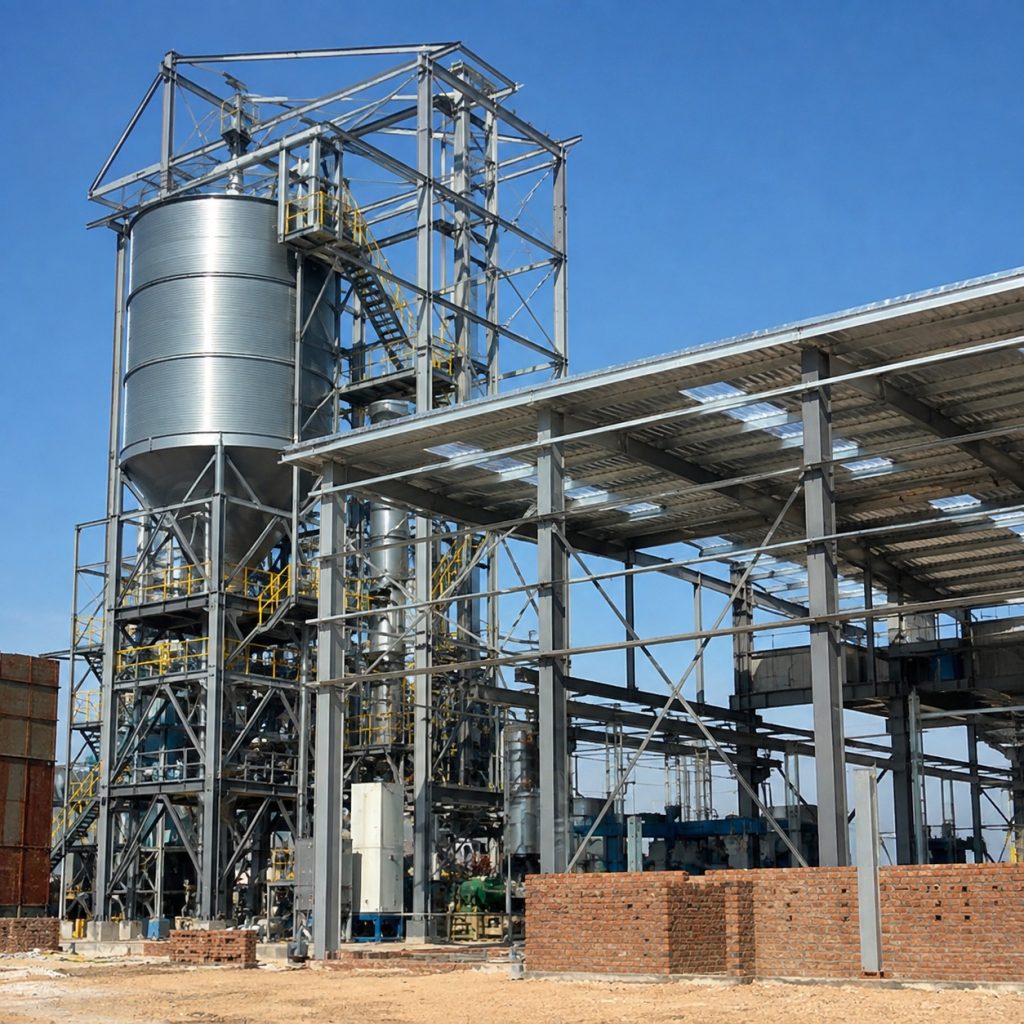
Silo Fabrication Process and Techniques
- Design and Material Selection:
- The process begins with a detailed design based on the stored material’s properties (density, flow angle, corrosiveness), required capacity, and site conditions (wind, seismic zone).
- High-quality structural steel plates (e.g., ASTM A36, Q235, or Q345) are selected. Thickness is crucial, as it varies from top to bottom due to increasing load pressure.
- For corrosive materials like some cement components, stainless steel or specialized internal coatings are specified.
- Plate Preparation:
- Steel plates are cut to precise dimensions using advanced techniques like CNC cutting or plasma cutting to ensure clean edges and dimensional accuracy.
- The plates are then rolled into the required cylindrical or conical shape using rolling machines.
- Assembly and Welding:
- Welded Silos (Fully Welded): These are often fabricated in sections at the workshop and then assembled and welded on-site, or fully fabricated in the shop and shipped for smaller sizes.
- Welding Quality: Critical seams (shell, cone, support joints) require high-quality welding, often using Submerged Arc Welding (SAW) or MIG welding with certified welders, to ensure $100\%$ penetration and structural strength.
- Non-Destructive Testing (NDT): Methods like ultrasonic testing or dye penetrant inspection are performed on critical welds to verify integrity and prevent leaks.
- Bolted Silos (Modular): These are fabricated as prefabricated panels (often corrugated or galvanized steel) and assembled on-site using high-strength bolts, which speeds up construction and simplifies transport.
- Integration of Flow Aids:
- The conical hopper section requires precise fabrication, ensuring the correct cone angle (often $60^\circ$ for fine powders like putty raw materials) is maintained to promote gravity-assisted material flow.
- Openings for manholes, inspection ports, fill lines, level indicators, and discharge nozzles are precisely cut and reinforced during this stage.
- Corrosion Protection and Finishing:
- After fabrication, all weld spatter and sharp edges are ground smooth.
- The steel surfaces are prepared (often by grit or sand blasting) to achieve a surface profile suitable for coating adhesion.
- Anti-corrosion coatings (e.g., rust-inhibitive primer and polyurethane topcoats, or specialized epoxy interior coatings) are applied to the exterior and often the interior to ensure longevity and material protection.