
- Home
- Arm Crane
S S Make Arm Cranes (1 Ton Capacity)
Introduction
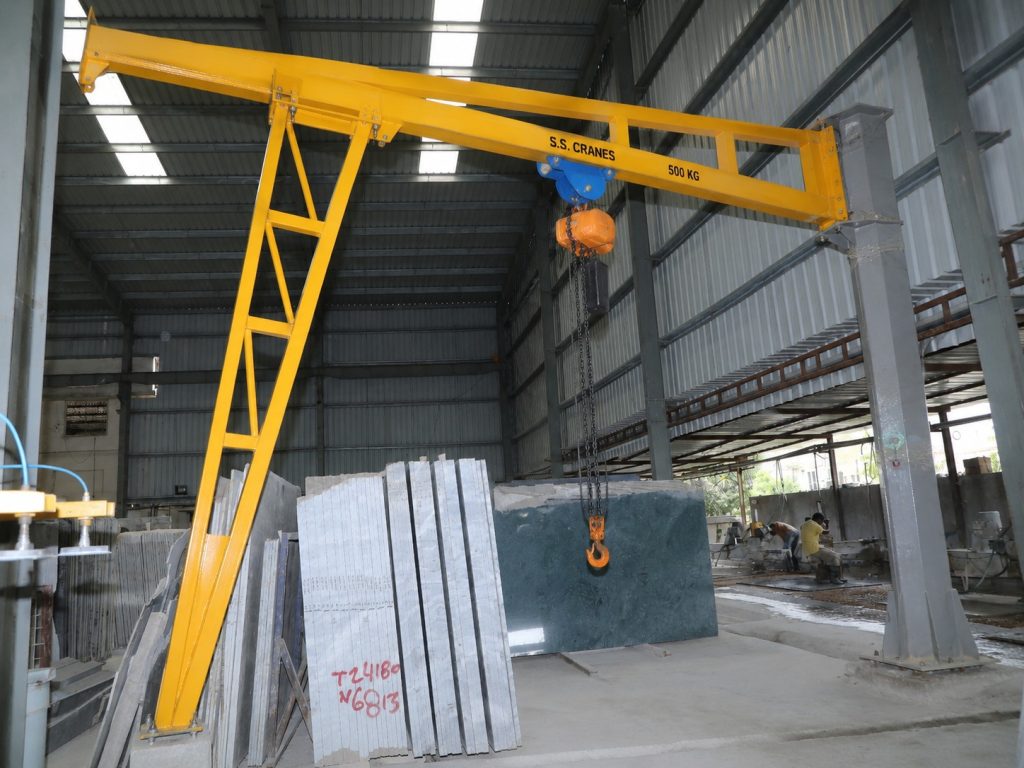
The Arm Crane (also known as an jib Crane or Boom Crane) is a highly localized and flexible lifting solution essential for boosting productivity in workstations and assembly areas. It is characterized by a horizontal member called the jib or boom, which is fixed to a vertical mast or column (for freestanding models) or attached directly to a wall or structural building column.
This design allows the hoist and trolley to traverse the length of the jib and rotate in a full or partial circle around the support structure, providing an efficient, circular work area without interfering with overhead bridge cranes or floor traffic.
Our featured model, with a 1-ton lifting capacity, a generous 16-foot arm length (span), and a commanding 16-foot column height, is engineered for maximum reach and hook height, making it ideal for large work cells.
Key Features and Superior Components
1
Capacity
Rated for 1-ton (2000 lbs), suitable for heavy tooling, dies, engine components, and assemblies.
2
Reach and Coverage
The 16 ft. arm length creates a large, dedicated work envelope, maximizing productivity within the area.
3
High Hook Height
The 16 ft. column height provides excellent vertical clearance for stacking or lifting loads over tall equipment.
4
Premium Hoisting
Utilizes imported-make chain or wire hoists for:
Superior durability and reliability.
Precise load positioning and smooth motion control.
Reduced maintenance and increased lifespan.
Robust Structure: Constructed from heavy-duty steel to ensure stability and minimal boom deflection under full load.
Rotation: Typically offers 270-degree rotation (for freestanding column models) or up to 180 degrees (for wall-mounted models), providing comprehensive access to the work area.
Space Efficiency: Does not interfere with large overhead bridge cranes or essential floor traffic.
1. Primary Uses and Applications
The crane is ideal for precise spot-lifting and high-frequency handling in localized areas:
Machine Tool Servicing: Used to quickly load and unload heavy materials, molds, or dies onto CNC machines, lathes, and presses.
Assembly Lines: Lifts and positions large sub-assemblies, jigs, or components at fixed manufacturing and assembly workstations.
Vehicle Maintenance: Essential for engine removal and re-installation or handling heavy transmissions in automotive workshops.
Welding and Fabrication: Positions and holds large metal sections or fixtures for welding and detailed fabrication work.
Complementary Lifting: Operates beneath large bridge cranes to service individual work cells, allowing the main crane to focus on bay-to-bay transfers.
Loading Docks: Efficiently moves materials to and from trucks and shipping areas.